
Portable handheld FT-IR spectrometer with an integrated gas cell
Characteristics
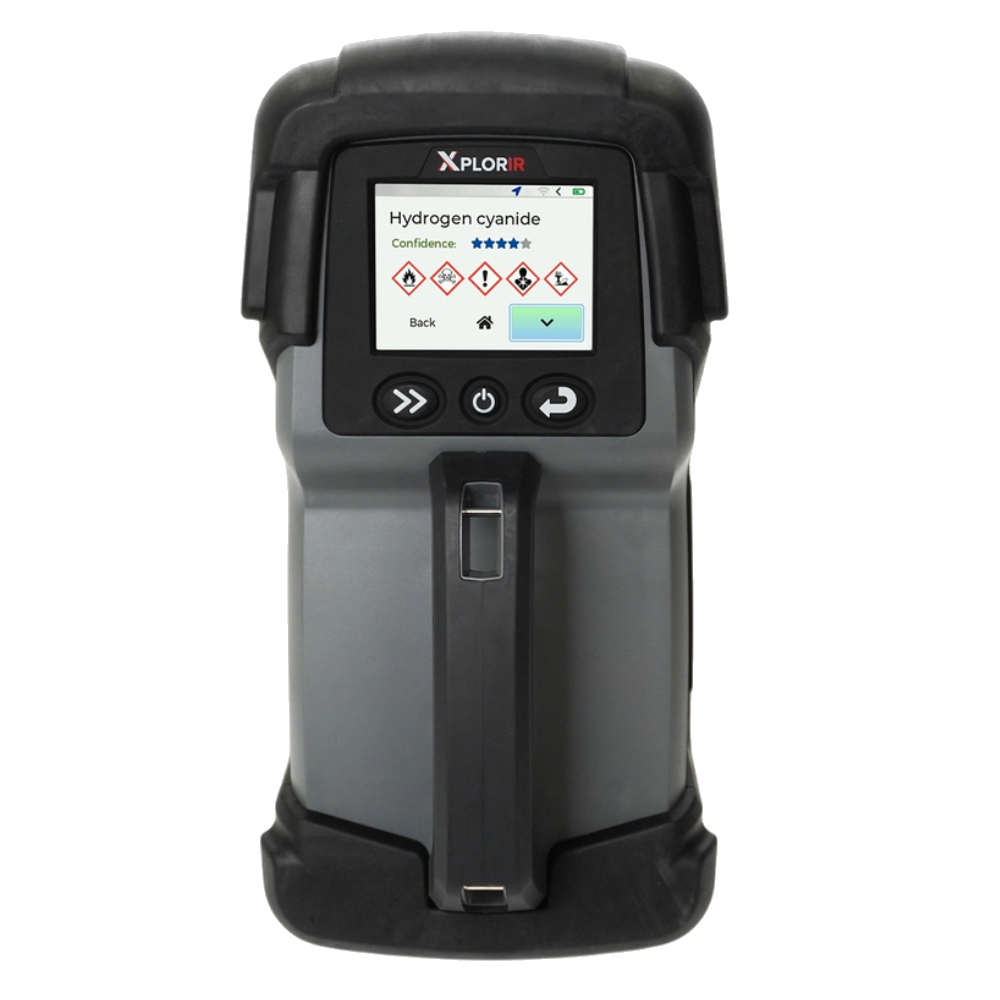
XplorIR is a unique and innovative portable handheld FT-IR spectrometer with an integrated gas cell which, at a weight of only 2.5 kg, enables the rapid detection and identification of more than 5,600 vapors and gases directly in the field, while also providing quantitative analysis of more than 5,000 substances. This analysis is also possible in mixtures of up to 6 components. The instrument is unique both in terms of the hardware used and the newly developed algorithms for fully automated analysis and continuous field monitoring, including the possibility of use in a hot zone (an environment contaminated with toxic substances). For the first time, response units (firefighters, civil protection, police, and the chemical industry) have access to a handheld instrument capable of reliably detecting such a wide range of gaseous substances without requiring specialized knowledge from the operator.
The hardware incorporates a full-performance FT-IR spectrometer with a spectral resolution of 4 cm⁻¹, covering the range from 650 to 4,000 cm⁻¹. The spectrometer is designed for field use under demanding conditions (vibration and temperature fluctuations). It is combined with a unique gas cell which, with an internal volume of only 38 ml, provides an effective optical path length of more than 1.8 m. This provides good sensitivity while also allowing the cell to be purged very quickly. The instrument can therefore respond rapidly to changes in the concentration of substances in the environment and is also suitable for locating sources of leaks. The instrument includes a pump that provides automatic sampling of the gas phase into the cell. The instrument can also be decontaminated, is optimized for use while wearing personal protective equipment, and provides a minimum operating time of 6 hours on a single battery.
XplorIR is equipped with a high-performance computing system that enables demanding chemometric analysis of infrared absorption spectra of gases and vapors at sufficient speed. In the past, computing speed was one of the limiting factors in the use of advanced algorithms for continuous automated analysis. FT-IR spectra of gaseous substances are often characterized by a complex structure (rovibrational spectra with a large number of peaks). This places greater demands on the analysis itself, but at the same time enables easier analysis of multicomponent systems than in the analysis of FT-IR spectra of solid and liquid samples. A significant challenge in FT-IR gas analysis is the intense spectrum of water and carbon dioxide, which is always present in the spectrum and must be corrected. Static correction has long been a commonly used method, but it generally results in higher detection limits for substances whose spectra overlap with the H₂O or CO₂ spectrum. An even greater challenge arises when continuous monitoring of an environment is required while the instrument is moving through it. In this case, CO₂ concentration and air humidity can change very rapidly. This was one of the reasons for the limited adoption of FT-IR spectrometers (large portable instruments) during emergency response operations. XplorIR represents a significant breakthrough in this area as well, using newly developed algorithms for dynamic background correction. These algorithms are capable of continuously and fully automatically compensating for the effects of CO₂ and H₂O over a wide range of concentrations (up to 90% relative humidity), while simultaneously improving detection limits compared with the static background compensation method. The following figure illustrates this clearly. On the left, the spectrum after static correction is shown in blue, with the 30 ppm SO₂ spectrum highlighted in yellow. On the right, the same situation is shown using the newly developed adaptive correction algorithms, which significantly improve the detection of low concentrations while also dynamically responding to changes in H₂O and CO₂ concentrations.

The second unique feature is the implementation of algorithms for fully automated multicomponent analysis. The software automatically analyzes mixtures of up to six components, and the identification confidence is displayed separately for each substance detected (expressed as a number of stars, with five stars representing a hit score greater than 0.95). This analysis is performed continuously, and all substances in the library are always considered (i.e., more than 5,600 substances are identified simultaneously).

The final unique feature is the implementation of automated quantitative analysis, in which the concentration of each detected substance in ppm is immediately displayed. The CO₂ concentration in the air is also always displayed. This information is updated every 4 seconds, allowing the instrument to dynamically display changes and making it suitable for rapidly locating leak sources, monitoring ventilation in an affected area, or monitoring conditions in the workplace during intermittent operations.
All these functions are integrated into a simple and highly readable user interface. Although complex mathematical operations are performed in the background, the analysis itself is very straightforward for the user and the instrument is easy to operate. The instrument can therefore be easily used by response units even while wearing heavy personal protective equipment. The system also includes communication capabilities (the instrument has built-in GPS and Wi-Fi), and results can be transmitted immediately from the hot zone to a cloud-based solution, where they can be further processed in the TeamLeader application, which is available for Android, iOS, and Windows.
No comparable instrument has previously been available on the global market. Until now, such systems consisted of large and heavy instruments (typically 8 to 12 kg). The number of substances that could be identified simultaneously was significantly limited. Preparation for use required 20 minutes or more (XplorIR is ready within 1 minute), and operation required a well-trained specialist with experience in evaluating the acquired data. XplorIR democratizes this technology and opens up broad possibilities for practical deployment, as the operator does not need to be a specialist in this field.
