
Handheld Raman Spectrometer
Characteristics
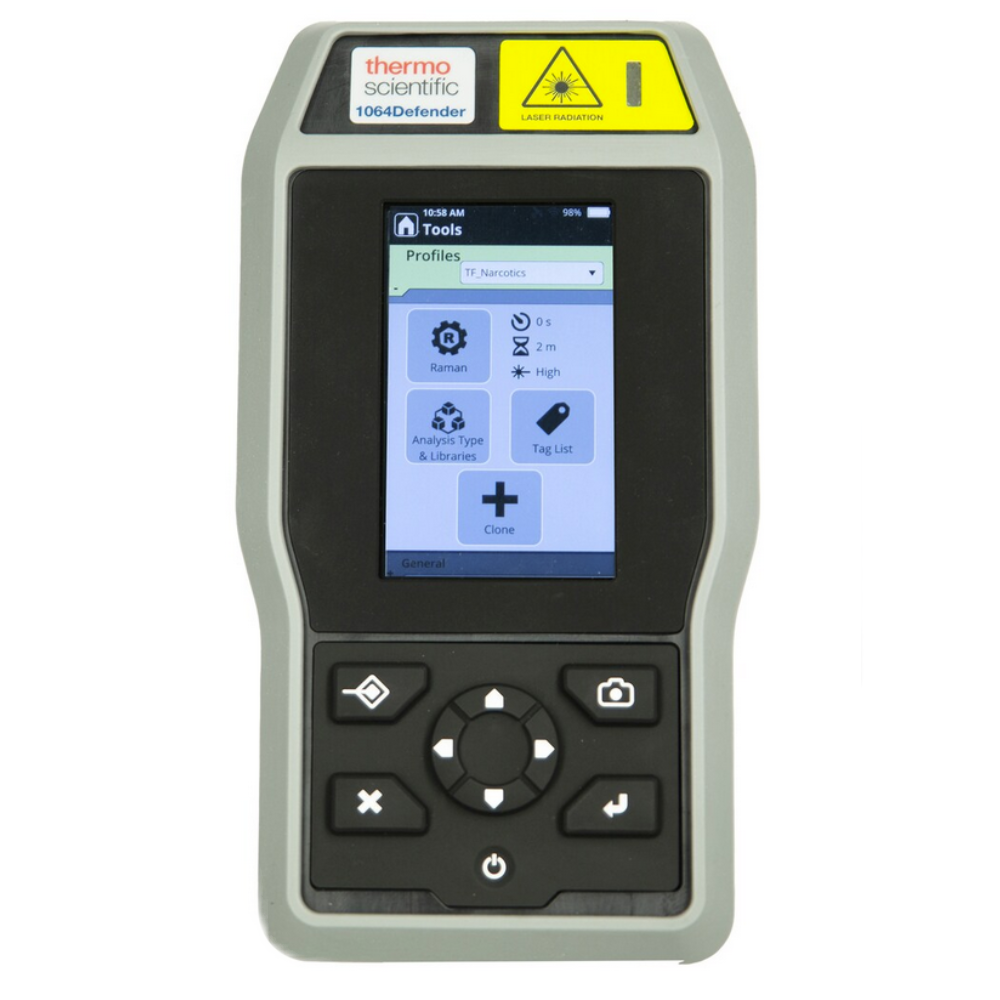
The 1064Defender spectrometer is a new addition to Thermo Scientific's portfolio of handheld Raman spectrometers designed primarily for security applications. The spectrometer builds on the commercially successful FirstDefender spectrometers and fills a gap in Thermo's portfolio—a handheld Raman spectrometer with a 1064 nm excitation laser. Thermo Scientific now offers one of the most comprehensive portfolios of handheld instruments for hazardous substance identification.
The instrument is primarily intended for the analysis of hazardous substances where thermally unstable samples (explosives, primary explosives, etc.) are not expected. Its main areas of application are therefore drug analysis, food safety inspection, analysis of hazardous waste and toxic agrochemicals, and environmental emergency response—in other words, applications where the use of a 1064 nm excitation laser offers significant advantages.
At the same time, it is important to bear in mind that the physical limitations associated with the use of a 1064 nm excitation laser (NIR laser) still apply—namely, a higher risk of initiating thermally unstable samples and fluorescence from certain glass containers.
The 1064Defender currently incorporates the most advanced technologies available and sets new standards in the category of handheld or portable Raman spectrometers with 1064 nm lasers, just as the FirstDefender RMX instruments did in the past. They remain the clear choice when measurements are required through thick glass containers or through glass containers with a higher content of rare-earth elements (which exhibit strong fluorescence when excited at 1064 nm) and especially when there is a risk of encountering energetically unstable materials.

Advantages of the 1064Defender Spectrometer Compared with Existing Spectrometers Using 1064 nm or 1030 nm Lasers
- Better actual spectral resolution, higher-quality spectral data, and high analysis speed
- Traditionally high robustness and durability – the product not only meets the requirements of MIL-STD-810H and IP68, but its in-house manufacturing and design also fully comply with the requirements of the U.S. military.
- Complete portfolio of algorithms developed and patented by Thermo (and previously by Ahura Scientific). A significant advantage remains in this area, providing important differences in performance, particularly through the following features:
- Automatic optimization of analysis parameters during measurement based on advanced algorithms, including continuous spectral background compensation. The latest generation of detector and electronics, combined with the algorithms used, also ensures a high dynamic measurement range even when using an InGaAs detector. The detector does not become saturated when analyzing highly fluorescent samples. The following figures demonstrate the quality of spectral data obtained from samples with high intrinsic fluorescence and compare the results with those from typical Raman spectrometers using a 785 nm excitation laser. Particularly interesting is the comparison for certain red wines: the 1064Defender provides a high-quality spectrum with a measurement time of just 10 seconds and is therefore able to reliably and rapidly identify cocaine dissolved in red wine.
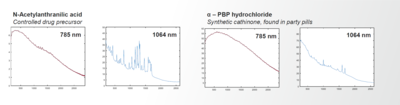
- Automatic optimization of analysis parameters during measurement based on advanced algorithms, including continuous spectral background compensation. The latest generation of detector and electronics, combined with the algorithms used, also ensures a high dynamic measurement range even when using an InGaAs detector. The detector does not become saturated when analyzing highly fluorescent samples. The following figures demonstrate the quality of spectral data obtained from samples with high intrinsic fluorescence and compare the results with those from typical Raman spectrometers using a 785 nm excitation laser. Particularly interesting is the comparison for certain red wines: the 1064Defender provides a high-quality spectrum with a measurement time of just 10 seconds and is therefore able to reliably and rapidly identify cocaine dissolved in red wine.
Red wine Torres – Raman spectrometer with a 785 nm excitation laser

Red wine Torres – 1064Defender Raman spectrometer
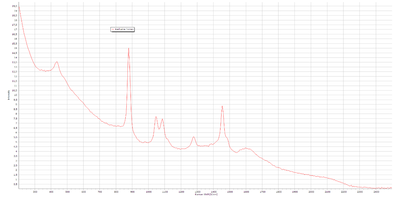
- The spectrometer always works with the complete RAW spectrum without aggressive digital filtering of the data (a prerequisite for true probabilistic analysis). The user can always see what the actual spectrum looks like, while false-positive identifications are avoided for samples that do not produce a usable Raman signal or whose Raman spectrum is of poor quality (e.g., highly fluorescent samples or samples with no Raman signal). This is a fundamental problem with spectrometers that use aggressive data filtering as the first processing step. Although the user may see attractive, idealized spectra with no noise, “noisy” signals can result in the generation of spectral peaks that are merely artifacts generated from noise and do not represent the actual spectrum. This can lead to false-positive identifications even for samples that cannot be measured, where the appropriate analysis result should simply indicate that the sample cannot be identified using Raman spectroscopy.
- Chemometric algorithms based on probabilistic analysis – providing greater identification reliability, particularly for multicomponent mixtures and spectrally complex samples.
- Combines algorithms known from the Gemini and FirstDefender instruments, including the option of tagging (ID mode), where the result is a list of identified substances, with algorithms used by the TruNarc spectrometer (Screener mode), optimized for the analysis of real-world drug samples. The result is Alarm, Warning, Clear, or Inconclusive, together with the name of the identified substance. More information about the algorithms used in the TruNarc spectrometer can be found in our earlier application note Trends in Field Drug Analysis (download here). The user can easily switch between ID and Screener modes or create different profiles using a predefined spectral-data evaluation mode. Thermo Fisher describes Screener mode as providing results such as alarm, warning, or clear to help users determine what action to take.
- New and enhanced user interface. It still follows the design philosophy of the FirstDefender and Gemini instruments. Existing Thermo users can therefore operate the instrument with minimal training, while the new interface adds a number of additional functions. An example of the interface in sample measurement mode is shown below.

- User profiles can be created with different levels of permitted functionality.
- Improved interface for viewing spectra on the spectrometer. An interesting feature is the comparison of spectra for mixture samples. The measured spectrum, the theoretical spectrum of the mixture, and one spectrum for each pure substance contained in the mixture are displayed simultaneously. Pressing the arrow cycles through the spectra of the other pure substances identified in the mixture. It is also still possible to overlay spectra from the library or spectra of previously measured samples.

- New connectivity options – a web interface, including an interface for mobile phones. The spectrometer can be connected to a PC, tablet, or phone via Wi-Fi or USB (Type-C), allowing the spectrometer interface to be opened in any web browser. From there, users can configure profiles and communication settings and, most importantly, view data, export spectra, print reports, etc. All software runs directly on the spectrometer, so the instrument can be accessed from any PC without the need to install software.


Would you like more information? Would you like to try out the capabilities of the 1064Defender spectrometer? Contact us and we will provide you with a demonstration. The spectrometer itself is available at our company.
